

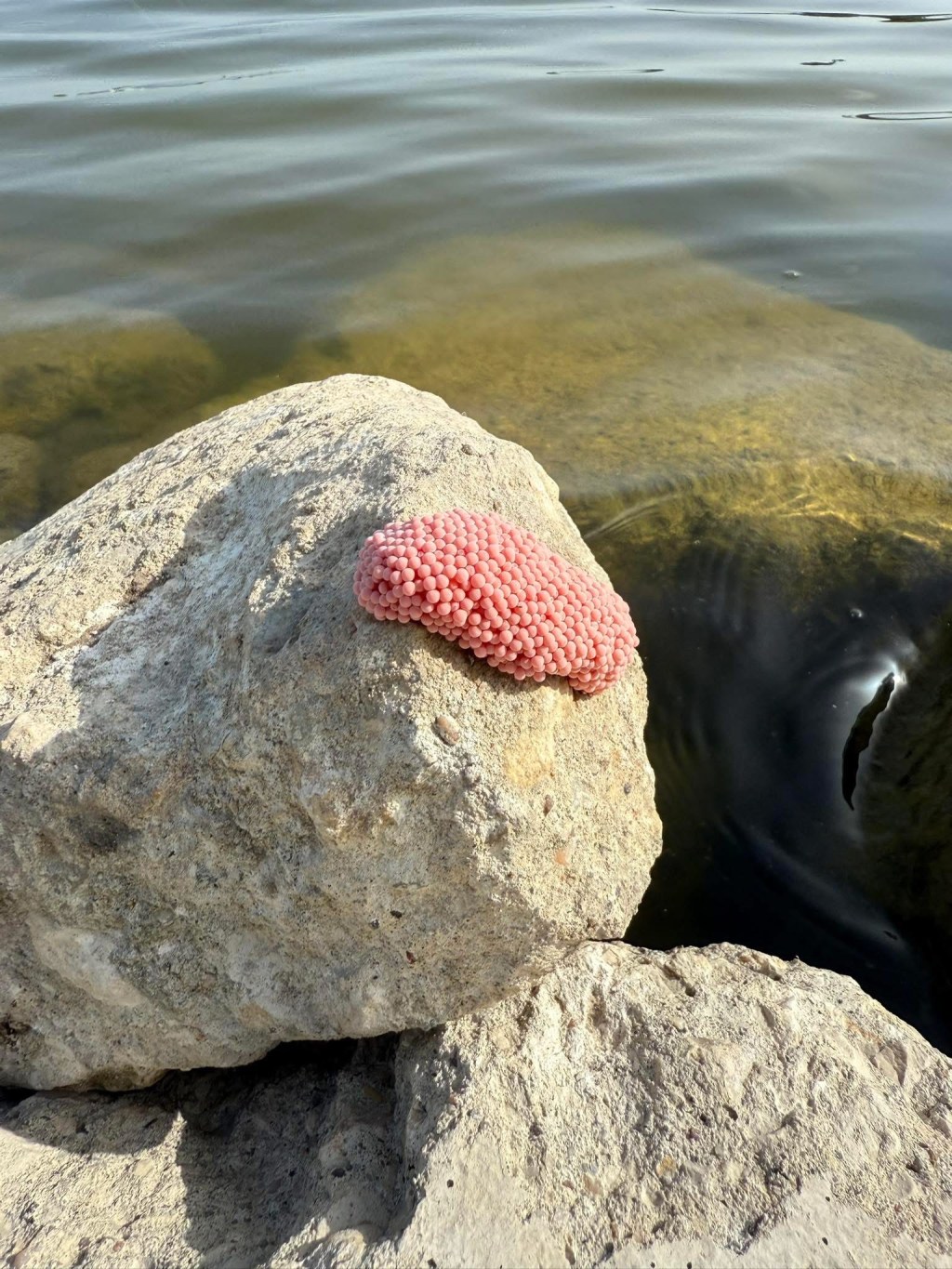
COUNTYWIDE – A cluster of bright pink eggs was found on the shore of League City’s Willow Pond. Anyone curious may not be prepared to hear the real truth, and while this may not be a new problem, these eggs are still quite dangerous.
According to Texas A&M’s AgriLife County Extension Agent Brock Sanford, these tiny eggs belong to the species Pomacea maculata, also known as the Apple Snail. Native to South America, these snails have made their way to Texas through dumping of aquariums, Asian aquarium trades and backyard projects. Despite the snails appearing harmless, females lay an egg mass of hundreds of eggs every 5 to 14 days.
Sanford included that the snails are aggressive herbivores. Their monstrous appetite can lead to habitat degradation for fish and aquatic wildlife, rapid erosion, challenges for wetland restoration and have potential future damage to rice farming in Texas, as they’ve already caused major crop losses in Asia.
“They also pose a human health risk,” Sanford said. “These snails can carry the rat lungworm parasite (Angiostrongylus cantonensis), which, if accidentally ingested, can lead to eosinophilic meningitis, a serious brain infection. Do not eat them.”
League City local Matt Wild also told KGTX 7 News that he found the specimen in Friendswood Lakes, and was aware of the risk on contacting.
“…I’ve always made sure not to make contact with them with any exposed skin when I dispose of them,” Wild said. “As a transplant from southwest Louisiana, I know how big of a commodity our rice crops are, especially for our local farmers. Last thing I want to see is an invasive species doing harm to them…the more awareness, the better.”
If you ever notice these eggs, Sanford has the following advice:
- Do not touch with bare hands — the eggs may contain toxins as a natural defense.
- Use disposable gloves or a tool to scrap the eggs off above-water surfaces.
- Crush the eggs or place them in a sealed plastic bag and throw them in the trash — do NOT scrap them into the water, as that may allow them to hatch.
Sanford also advised if anyone were to find an infestation, they can voluntarily report it by taking a picture, noting the location, and submitting it to https://www.texasinvasives.org/action/report_detail.php
Photo credit: Matt Wild, Facebook.
Editor’s Note: To avoid confusion, this is not a new issue for Galveston County. This article merely sheds light on recent reports from the community as a PSA.





 KGTX 7 Galveston County